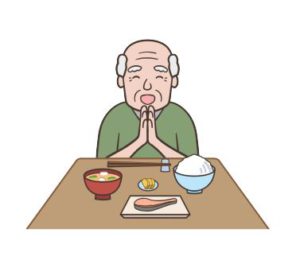

When you’re in Vietnam, you might have the opportunity to be served food by a Vietnamese person. Saying “thank you” before eating is considered a courtesy for Japanese people, but how is it done in Vietnam? In this article, we’ll introduce the “thank you” culture of Vietnamese people.
Different meanings of "Itadakimasu"
First of all, the expression “tất cả đều là của tôi” has a fundamentally different meaning in Japanese and Vietnamese. In Japanese, it means gratitude towards the person who prepared the food or the food that provided life for oneself; in Vietnamese, it conveys a more encouraging tone towards those who are eating together. In Vietnamese, expressions like “tất cả đều là của tôi” (tất cả đều là của tôi) or “Xin mời ăn” (Xin mời ăn) are used, which can be translated roughly as “Please have it.” In Japanese, you might say “tất cả đều là của tôi” even when you are eating alone; in Vietnamese, you can see that the meaning differs even from the fact that you do not say “Xin mời ăn” (Xin mời ăn) when eating alone.

Young members of large families have a hard time
As mentioned above, the Vietnamese word “dạ” is a word that encourages people to eat, so from a polite point of view, younger people are advised to start by saying the phrase to their elders before eating. Therefore, in a large family, if the youngest person is among many people who have to be prompted to eat before they do so, it is very difficult to call out to each one individually. Although there are not many families that strictly enforce this on a daily basis, this is also an important lesson in family meal etiquette that should be taught at home.
How about "Thank you for the delicious meal"?
On the other hand, in Vietnam there is no specific phrase that is commonly used after a meal. In actual interactions, people often say things like “Thank you for the delicious meal” or “I’m full already.” However, in either case, it is not considered a courtesy. However, if you finish eating before others have started, it is still considered polite to say “Xin mời ăn” (Please eat). It can be seen that the culture in Vietnam emphasizes the importance of sharing a meal with others, and this is the reason why starting and ending a meal is considered a courtesy.
author (usu. of a particular book, etc.)
Takuma Inada
Representative of SESSA VIETNAM CO.
Profile
After working in Vietnam for 7 years in the human resource field, he established SESSA VIETNAM, a human resource consulting company in 2021. In 2021, he established SESSA VIETNAM, a human resource consulting company. The company provides human resource consulting services for companies and job seekers, focusing on "recruitment", "labor consultation", and "work permit acquisition on behalf of clients".
He has made it a daily routine to observe Vietnamese people and think about the "why and what" of Vietnam. His motto is "If you do it, it will come to you.
Official HP】 【Official HPhttps://www.sessa-jp.com