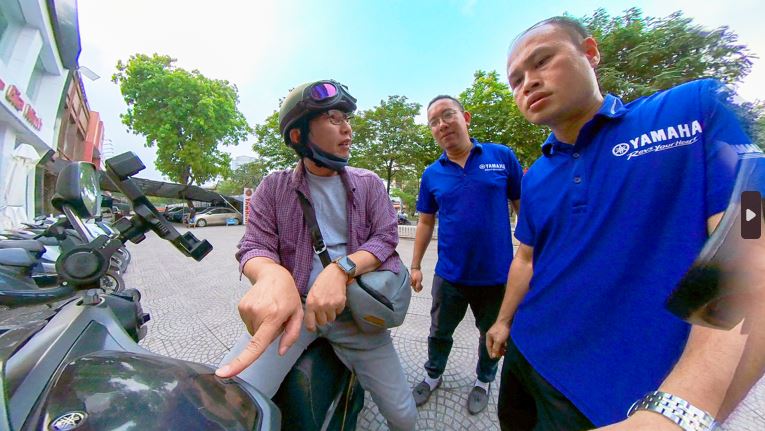


A convenient way to live with a motorcycle
Walking VietnamI believe that everyone who reads this magazine is visiting Vietnam for various reasons, such as traveling, business trips, or long-term stays. During your stay, you will need to get around. Whether it’s dining, sightseeing, shopping, or going to work. Among the various transportation options, the most common is taxis or ride-hailing apps like Grab.
Taxis are considerably cheaper than in Japan, and they are easy to use. However, first of all, it is very difficult to catch one, and it is also difficult to tell the destination. Paying in cash in Vietnamese dong is very confusing, and it is a constant struggle. Some drivers even charge a huge amount for the meter.
There are also scams. Using ride-sharing apps like Grab makes it easier to catch a taxi than using a car, but since the drivers are amateurs, they get lost on the way, get cancelled out of nowhere when they think they’re close, and it’s also very difficult to catch a taxi during the morning and evening rush hours, so it’s still very frustrating.
What if you could drive a motorcycle yourself? You would be free from all the hassle and could go anywhere whenever you want. Recently, due to the economic development in Vietnam, the number of young people owning a car has increased rapidly. But motorcycles still remain the main players.
In cities, the rush of motorcycles that has become a familiar sight—with people racing to get ahead of each other at intersections—is frankly not considered safe compared to Japan. However, if you avoid the morning and evening commuting hours, you can get by relatively safely. I myself have been riding a motorcycle in Vietnam for about three years now, and so far I haven’t encountered any dangerous situations.
How to drive a motorcycle in Vietnam?
Driving a motorcycle requires a license. However, in Vietnam today, motorcycles under 50cc, also known as scooters or electric motorcycles in Japan, do not require a license. Motorcycles over 50cc require a license, but international driver's licenses obtained in Japan cannot be used. This is because Japan and Vietnam are both parties to the Geneva Convention and the Vienna Convention on Road Traffic, and the international conventions on road traffic that both countries have signed are different. Therefore, if a Japanese person wants to drive a motorcycle in Vietnam, they must obtain a Vietnamese motorcycle license.
That said, it’s impossible to take an exam in Vietnamese for a driver’s license. But that’s okay. There are two ways for Japanese people to obtain a Vietnamese driver’s license: in either case, the requirement is that you have a visa to stay in Vietnam for at least three months. If you’re entering Vietnam on a tourist visa or the like, unfortunately, you can’t obtain a driver’s license; you’ll have to get a 50cc motorcycle or an electric motorcycle instead.
If you have a visa or temporary residence permit for more than 3 months, the first method is to obtain a Vietnamese license based on the content of your Japanese license. This is called switching licenses. In this case, the requirement is that you must have a license for motorcycles of at least a small motorcycle. A license for a motorized two-wheeler that comes as a bonus with a car license is not allowed. Vietnamese motorcycle licenses are classified by engine capacity, with A1 being an automatic motorcycle with less than 175cc, and A2 being an automatic motorcycle with more than 175cc. If you have a license for a large motorcycle in Japan, you can also switch to an A2 license.
I have a Japanese driver's license, but I don't have a motorcycle license. But for those who want to drive in Vietnam, there is another option. First, you can first switch your Japanese driver's license to a Vietnamese driver's license, and then take the practical driving test to obtain A1 certification. There are also conditions here, and if your Japanese driver's license is limited to AT vehicles, you cannot switch to a Vietnamese driver's license, so be careful.
The process of obtaining a license
Obtaining a Vietnamese driver's license based on a Japanese license requires a so-called conversion. First, you will have to have the Japanese license translated into Vietnamese. You should contact a notary public or a company that specializes in translating documents of this kind. The cost ranges from about 500 yen to several thousand yen, and the time required and the location of the service vary considerably. Once the translation is completed, you should go to the Department of Transportation with your passport, visa, or residence permit, and a copy of your Japanese driver's license (submitted at the time of application) and the original (submitted at the time of application). Fill out the application and request the conversion.
If you already have a motorcycle license and want to switch directly, this process is complete. The process takes 5 business days to complete, but in the end it can take about 2 weeks, so if you have any upcoming plans, it’s best to proceed with the procedure with a little leeway.
On the other hand, if you need to switch from driving to taking a practical driving test. You can have this done by a company that helps you get your license, for example. Of course, you’ll need to learn Japanese as well.
Since English isn’t understood either, it’s best to have someone who can speak Japanese help you. The practical exam includes things like the “8-character” and the “wave-like path,” but it doesn’t seem too difficult. However, the “8-character” is quite narrow, so it might be a bit difficult for those who are not used to motorcycles. We strongly recommend that you practice beforehand. There are signs of the “8-character” written on the sidewalk near the exam venue, and there are many people practicing there.
Be careful with your motorcycle life
As mentioned at the beginning, it is certain that driving a motorcycle is more dangerous than in Japan, so please make your own judgment based on personal responsibility. Cars and motorcycles drive on the right side of the road, which is the opposite of Japan. Especially when you are not used to it, you may accidentally end up in the wrong lane when turning right or left. Be careful. Above all, do not speed. Urban areas are extremely crowded and especially dangerous, so avoid rush hours in the morning and evening, and gradually get used to it during quieter times.
With more cars on the road these days, motorcycles are advised to stay on the side of the road in places with multiple lanes; that is the unspoken rule or the signage. Cars are also quite aggressive and honk frequently. Please give way without fighting over the right of way. In Vietnam, larger vehicles have priority; pedestrians come last. Life is at stake, so it is important to respect the local customs.
Regarding how to get a motorcycle, I recommend trying it with a rental bike first. The average price is around 200,000 VND (about 1200 yen) per day. If you want to own your own motorcycle after staying for a long time, it is safest to buy from a Japanese person on a “sell/buy” board (if you decide to return home and want to get rid of your motorcycle). Otherwise, you can try a used car dealership. The used cars are very limited, and it is very difficult to get a bad one. I recommend having a male Japanese person who speaks Vietnamese locally accompany you.
On my channel, I also show you how to go out and buy a motorcycle, how to go see one, and how to get it repaired when it breaks. If you’re interested, please come and see it.


author (usu. of a particular book, etc.)
Kaz
Profile
Born in 1970
IT Advisor for locally hired Japanese Vietnamese IT company
Born in Hamamatsu, Shizuoka
Self-taught in Vietnamese for 3.5 years
Channel Motto
Fun! Easy to understand!
YouTube]https://www.youtube.com/c/ChannelKaz