Don't you remember Vietnamese words in kanji? The real reason why you can't understand them
When you first started studying Vietnamese, didn’t you ever memorize words in kanji like “Xin chào” (Hello) and “Cảm ơn” (Thank you)?
When you open a dictionary before a trip or write the pronunciation in a note on your smartphone, kanji are very useful. Often, they are thought of as an excellent "entrance" for speaking unfamiliar words out loud. However, there is a major pitfall in this approach.
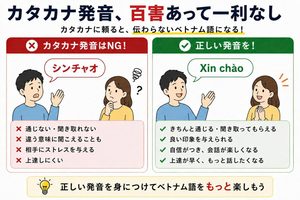
To be clear, learning Vietnamese using kanji is a losing proposition. There is no one who can speak Vietnamese to a certain extent who uses kanji. The reason is that when you try to speak Vietnamese using kanji to a Vietnamese person, it doesn’t work at all.
There are several reasons why they don’t translate; the biggest reason is the “tone.” There are six tones in northern Vietnamese. Even sounds that Japanese people represent as the same “ma” in Vietnamese have different meanings because the height of the voice and movement change.
In other words, just writing "ma" in katakana leaves out important information. It's like giving a song without teaching the melody and just saying, "Please sing this song." It's a common sense thing, but even if the lyrics are correct, if you don't know the pitch of the notes, it won't be the original song. The same goes for Vietnamese, where the word only becomes a real word when you include not just the letters but also the pitch of the notes, the height of the notes, and how they end.
The method of reading katakana in Vietnamese sounds like a useful starting point for beginners. However, if you memorize it from the beginning in katakana, you will have to correct it later to the original pronunciation, which will result in a considerable detour. The key is to listen to the actual sound, and memorize it in combination with the shape of the mouth, the position of the tongue, and the tone of the voice.
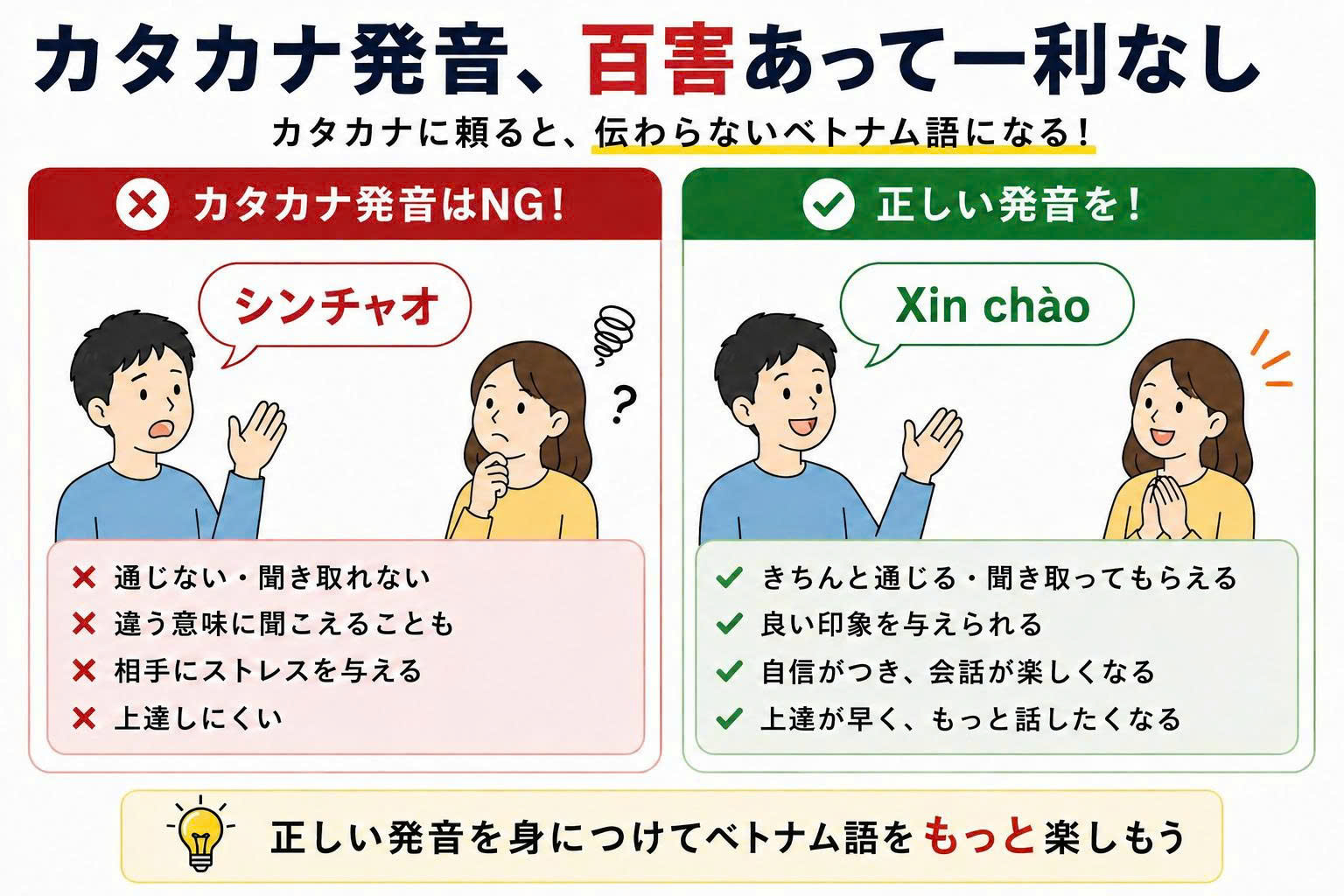
Rather than memorizing 100 words in kanji, first make sure that the 10 words are pronounced correctly so that they are understood by Vietnamese people. That way, Vietnamese will become more fluent in the language much faster. And the more small successes like “I understood!” happen, the more enjoyable conversation itself becomes.
If you want to learn Vietnamese as quickly as possible, try to start by adopting the habit of learning not only the letters but also the sounds.
Infor
ZEN COMPANY LIMITED
COO Kanaya Akiko
He moved to Vietnam in 2016 and has been living there for 10 years. He has a unique background as a former police officer. Currently, as COO of the Japanese-language education institution ZEN Foreign Language Center, he teaches practical pronunciation methods that make it easier for Japanese people to communicate quickly.